 Technical Lodge No 5666
Technical NO 5666 Blog
How the name of the Supreme Being changes through the three Degrees
By W Bro Anthony James PPJGD, Technical Lodge No.5666 Lodge Mentor
It’s one of those details you can sit through for years without really noticing. In English Craft ritual we don’t refer to the Supreme Being by the same title in every Degree. The Entered Apprentice hears of the Great Architect of the Universe. The Fellow Craft hears of the Grand Geometrician of the Universe. And the Master Mason hears, more simply, of the Most High.
In many English workings, Emulation among them, you’ll catch it most clearly when the Lodge is opened, because each Degree is declared open in a different name. Once you’ve spotted it, it’s hard to un-hear, and it’s natural to ask why.
One thing should be said straight away. These aren’t three different Supreme Beings, and Freemasonry isn’t trying to tell any Brother what God is. We are a fraternity of men from many faiths, and our ritual deliberately uses language broad enough for each of us to bring our own belief to it. What the changing titles do is something quieter. Each Degree asks us to look at life from a slightly different angle, and the way we name the Supreme Being shifts to match.
First Degree: the Great Architect
The Entered Apprentice is at the very start. Everything is new to him, and he is only beginning to learn the principles his Masonic life will rest on.
An architect is a fitting image for that moment. Before a single stone is laid, the architect has an idea and a plan. The foundations are thought through, the measurements worked out, and every part has a place it’s meant to fit. The architect stands for design, purpose and order.
That suits the First Degree well, because the Apprentice is beginning a building project of his own, and the building is himself. He is presented as rough material that can be improved. The working tools of the Degree teach him to look honestly at his character, knock off what doesn’t belong, and start shaping himself into a better man. At the outset, then, the lesson is a simple one: there is a design, and there is work to be done.
Second Degree: the Grand Geometrician
The Second Degree changes direction. The Fellow Craft isn’t just being told to start building; he’s being encouraged to learn, to think and to investigate. This is the Degree of the intellect and of the Seven Liberal Arts and Sciences, and among those, Geometry holds a special place in Masonic symbolism. The letter G, so prominent in this Degree, is explained to the candidate as denoting the Grand Geometrician of the Universe.
So the title moves from Architect to Geometrician, and the difference is subtle but real. The architect conceives the building. The geometrician understands the measure, proportion and relationships that allow it to stand. The First Degree asks us to recognise that order exists. The Second asks us to study it.
Geometry here means a good deal more than the angles we half-remember from school. To our operative forebears it was everything. Get the measurements wrong and a wall leans, an arch fails, and the great building never rises at all. Speculative Freemasonry takes that hard-won practical knowledge and turns it into a moral and intellectual lesson. The Fellow Craft is invited to look past the surface of things and ask how they fit together, what principles govern them, and what he might learn by paying closer attention to the world around him. A title rooted in measurement and proportion sits very naturally in a Degree given over to knowledge and reason.
Third Degree: the Most High
Then comes the Master Mason Degree, and the tone shifts. The language of building drops into the background. We’re no longer mainly concerned with plans, measurements or intellectual discovery. The subject has become deeper and more personal: mortality, fidelity, what makes a life well lived, and our relationship with something greater than ourselves. These are questions every one of us has to face in the end.
Here the Supreme Being is named simply as the Most High, and it’s worth noticing how different that feels. “Architect” describes what someone does. “Geometrician” describes how order can be understood. “The Most High” doesn’t describe an occupation at all. It describes a position: above us, greater than us, beyond the reach of anything we can measure or plan.
By this stage the Mason has learned something about building and something about understanding. Now he is asked to consider a larger question altogether, which is where he himself stands within creation.
One journey, three perspectives
Put the three side by side and a clear progression appears. The Entered Apprentice looks at creation and sees a Great Architect. The Fellow Craft studies it and finds a Grand Geometrician. The Master Mason, having thought about both the building and the principles behind it, lifts his eyes beyond them to the Most High.
Or, more simply: in the First Degree there is a design; in the Second we try to understand it; in the Third we consider what lies beyond it. The Apprentice learns to build, the Fellow Craft learns to understand, and the Master Mason learns to reflect.
That’s why these words matter. They aren’t ornamental scraps of old ritual. They help mark the character of each Degree. And throughout all three, Freemasonry leaves every Brother free to understand the Supreme Being according to his own faith and conscience. The titles don’t tell us who God must be. They invite us, at each stage of the journey, to look at that relationship from a fresh point of view.
Sometimes, just noticing why one familiar word has quietly given way to another is enough to bring us a little more light.
In a nutshell: Architect = design. Geometrician = understanding. Most High = contemplation.
By Bro. Ed Thompson
On Friday 2nd October, Technical Lodge held its annual Lodge of Instruction Open Night. The purpose of the event is for the LOI team to showcase their hard work throughout the year in the form a re-enactment of the Ceremony of Initiation. The Lodge of Instruction provides a platform for Brethren to learn new ritual, roles, offices and - crucially - to advance our Masonic knowledge. It is light-hearted and made to be fun - this undoubtably improves the learning experiences and outcomes.
Open Night is relatively laid-back too although there is a small added pressure of performing in front of a greater crowd - as well as visitors. The dress code is relaxed and no regalia is worn. Starting upstairs, the LOI Worshipful Master W Bro Dave Green opened the LOI Lodge with his Wardens and officers. I was Junior Warden and W Bro Allan McKay sat to my left in the Senior Warden's chair - he was standing in for Bro Nandakumar Thekkootu Pisharam who was away (initially) with professional commitments. During the opening, the following Brethren explained their respective duties; Bro Draper as Inner Guard; Bro Hemingway as Junior Deacon; and Bro Gambles as Senior Deacon.
Staying true to the Ceremony of Iniation, the Secretary W Bro Laughton temporarily left the Lodge to ensure that the 'candidiate' W Bro Arash Vesali - (current WM of Technical Lodge) was in attendance and had signed the necessary paperwork - metaphorically in this context.
I will not divulge into the Ceremony itself except highlighting the Brethren who performed during it. Bro Draper admitted the candidiate in due and antient form. Bro John Hemingway - in his crucial capacity as Junior Deacon - guided and demonstrated the 'steps'. W Bro Dave Green entered W Bro Arash into the Obligation. Bro Hemingway explained the three Lesser Lights in Freemasonry. I temporarily relieved the Junior Warden chair to W Bro Rob Gorman (Assistant Director of Ceremonies) so that I could deliver to Arash the Communication of Secrets.
The Senior Warden W Bro McKay invested Arash with the apron of an Entered Apprentice. Bro Gambles highlighted the importance of charity at the North East Corner. Bro Paul Draper handed the Inner Guard chair over to W Bro Eddie Wildman (Organist extraordinaire) for a short time so Paul could present the Warrant of the Lodge. W Bro Mark Cusack explained the Working Tools of an Entered Apprentice Freemason and, finally, Bro Bill Turner-Bone imparted the Antient Charge. This concluded the major parts of the re-enactment and only a few more bits were left to do before Arash retired from the Lodge (not really).
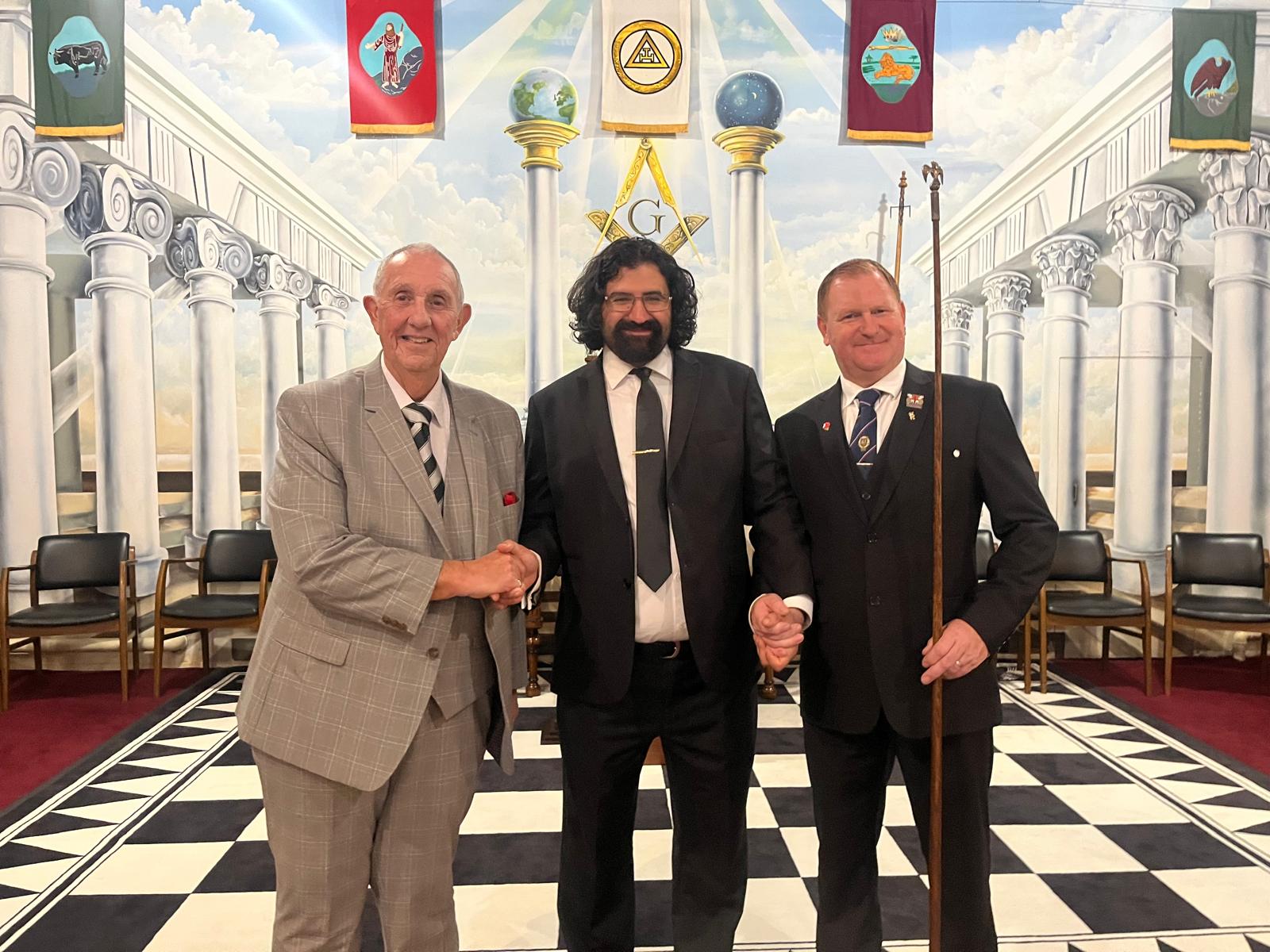
W Bro Eddie Wildman gave greetings as an Officer of the United Grand Lodge of England and congratulated all who participated. W Bro Anthony James - Tyler on the night - gave greetings from all Provincial Officers present. We had one visitor: W Bro Danny Betts and he gave greetings from Minerva Lodge No. 250 - we were grateful for his attendance. Finally, SW Bro Nandakumar Thekkootu Pisharam (who had since arrived during the ceremony) gave greetings on behalf of the Technical Brethren. After closing, our 'candidate' W Bro Vesali posed with LOI Worshipful Master W Bro Dave Green (Left) and Junior Deacon Bro John Hemingway (Right).
Downstairs, the Festive Board was joyful and equally raucous. I believe everyone involved in the working of the ceremony were relieved and proud - and the observers were satisfied (hopefully!). This led to a celebratory atmosphere; the climax of several months culminative of hard work - not just the couple of hours of that was performed upstairs.
As in the tradition of Open Night, numerous toasts were featured. W Bro Dave Green made the Toast to the 'Candidate' W Bro Vesali, who responded with humour and humility. W Bro Keith Challis toasted the Master and his Officers wholeheartedly and W Bro Green responded in that same theme of Brotherly Love. Bro Draper gave the sharp and cutting Toast to the Stewards, poking fun towards all the Past Masters who acted as Stewards for the evening. W Bro Mark Cusack responded and gave warning that soon enough, Bro Paul would be responding to the same toast in the future. I, as Junior Warden, proposed a toast to Absent, Sick and Sea Faring Brethren and chose to highlight the unfortunate abscenes of W Bro Frank Lovely and Bro Adam Tunnicliffe and wished them well. Bro Nanda - Senior Warden - toasted our sole Visitor W Bro Danny Betts who gave a brilliantly witty response.
Songs were sung, the Masonic Circle was formed and the Raffle and Parish Notices followed. It was a fun evening and hopefully enjoyed by all. With the curtain now closed on LOI (until early next year), attention now turns to our October Business Meeting, laying the foundation for the impending extravaganza that is Installation in November...
By Anthony James PPGJD
One of the things we sometimes overlook in Freemasonry is just how much learning takes place without anybody standing at the front of the Lodge and formally teaching us.
We often think of Masonic education as something separate from the meeting itself. We think of lectures, presentations, Solomon, mentoring sessions, books, papers or explanations given afterwards. All of those have their place, but there is another form of learning taking place throughout almost every meeting. In fact, we participate in it from the moment the Lodge begins its work.
When we stand to order, we are learning.
When we stand for prayer, we are learning.
When we assist in opening and closing the Lodge, we are learning.
When we rise and address the Worshipful Master correctly, we are learning.
None of these actions may feel particularly educational once we have been doing them for a number of years, but for a newer Brother they form part of what might be described as participative learning. We learn by taking part. We do not simply sit and listen to somebody tell us how a Lodge works. We gradually absorb it by becoming part of it.
Think back to your first few meetings. There was probably a surprising amount to remember. When should I stand? When should I sit? Do I salute now? How do I address the Worshipful Master? Why has everybody else suddenly moved? Where am I supposed to be looking? What happens next?
To the experienced Mason, these things become almost automatic. To the newer Brother, however, every meeting contains dozens of small lessons. Nobody necessarily stops the meeting to explain each one, but through repetition, observation and participation, they begin to make sense.
That is one of the quiet strengths of the Lodge. It teaches us by involving us.
There is, however, another kind of learning taking place at the same time, and I think this becomes particularly noticeable as we begin to progress through the offices.
We might call this perceptive learning.
As we move around the Lodge, our perception of it changes.
A Brother sitting on the sidelines sees the Lodge from one particular perspective. He watches the officers, follows the ceremony and begins to understand the rhythm of the meeting. When he later takes an office, however, something changes. He is no longer merely watching that part of the Lodge. He is experiencing it.
The Lodge begins to look different.
From one office, you become more aware of movement and timing. From another, you notice how much depends upon listening carefully. Elsewhere, you may suddenly appreciate the importance of preparation, confidence or knowing exactly what happens next. Something that appeared effortless when viewed from the sidelines can feel very different when you are the Brother expected to make it happen.
That change of perspective is important.
We are not simply learning a different piece of ritual. We are beginning to perceive the Lodge through the responsibilities of that particular office.
As we progress, we start to understand why officers do certain things in certain ways. We notice how different parts of the ceremony connect. We become more aware of the Brethren around us. We begin to appreciate that the Lodge is not simply a collection of individual offices, but a group of Brothers whose actions fit together to make the meeting work.
Then, eventually, some Brethren arrive at the Master's Chair.
And the Lodge changes again.
The room has not changed. The furniture has not moved. The Brethren are the same men you have sat beside, spoken with and shared meetings with for years. Yet from the Master's Chair, the Lodge can feel entirely different.
Suddenly, you are looking out across the whole Lodge.
You become aware of things that perhaps you never really noticed before. You see the movements of the officers from a different angle. You become conscious of pauses, timing and atmosphere. You notice when a Brother looks uncertain, when somebody needs a little help, when a piece of ritual has gone particularly well, or when somebody has quietly rescued a moment before most of the Lodge has even noticed there was a problem.
You also begin to appreciate the responsibility carried by the Worshipful Master.
It is no longer simply a chair at the east of the Lodge. It is a position from which the whole meeting looks and feels different.
That, to me, is perceptive learning in one of its clearest forms.
We learn not merely because somebody has explained the Master's role to us, but because our position changes our perception. Things we may have watched many times suddenly carry a different meaning when we are responsible for them ourselves.
And that principle applies throughout our Masonic journey.
The Junior Deacon does not see the Lodge in quite the same way as the Inner Guard. The Senior Deacon experiences it differently again. The Wardens have responsibilities and viewpoints that cannot be fully appreciated until we begin to occupy those places ourselves. Each office offers another perspective and, with it, another opportunity to understand the Lodge more deeply.
This is why participation matters so much.
It is very easy for us to tell a newer Brother that there is no rush and that he can simply sit back and enjoy the ceremonies for a while. There is nothing wrong with that, of course. Nobody should be pushed into office or made to feel uncomfortable. But there is also a danger that if we leave a Brother sitting on the sidelines for too long, we deprive him of one of the most effective ways Freemasonry teaches.
Participation creates understanding.
Even very small acts can make a difference. Asking a Brother to take a short piece of ritual, assist with a small duty, accompany an officer, help prepare the Lodge or simply explain what is happening gives him another way to engage with the meeting.
Once he participates, his perception begins to change.
He stops seeing the Lodge as something being performed in front of him and begins to recognise that he is part of it.
There is also another benefit.
Participation encourages questions.
Once somebody becomes involved, he often wants to know why something is done in a particular way. Why do we stand at this point? Why does that officer move there? Why is a particular form of words used? Why is this part of the ceremony important?
Those questions are valuable because they represent the point at which participation begins to develop into understanding.
And that is where mentoring becomes especially important.
A Mentor cannot possibly explain every detail of Freemasonry to a newer Brother in his first few months, nor should he try. Much of it would have little meaning because the Brother has not yet experienced enough of the Lodge for those explanations to connect with anything.
Sometimes the better approach is to allow experience to create the question.
Let the Brother participate. Let him observe. Let him experience the Lodge from different places. Then, when he asks why something happened or what something meant, the explanation suddenly has context.
It has somewhere to land.
This is perhaps one of the reasons progression through the offices can be so valuable. It is not simply a route towards becoming Worshipful Master. Each office can provide a different lesson because each one allows us to perceive the Lodge from somewhere new.
There should be no suggestion that every Brother must reach the Master's Chair. That is neither necessary nor desirable. Freemasonry is not a race through the offices, and advancement should never become the sole measure of a Brother's involvement. Some Brethren will progress quickly, others slowly, and some may decide that office is not for them at all.
But wherever we sit and whatever part we play, participation gives us another opportunity to learn.
There is a simple lesson here for all of us, not only Mentors.
When a newer Brother comes into our Lodge, we should not assume that learning means sitting him down and giving him more information. Sometimes the best lesson is simply to involve him.
Stand with him.
Explain what is happening when appropriate.
Give him something small to do.
Encourage him to visit a Lodge of Instruction.
Let him watch from different parts of the Lodge.
Allow him to discover that every seat, every office and every responsibility provides a slightly different view of the same institution.
Because Freemasonry is not really learned from one direction.
We learn by listening.
We learn by watching.
We learn by asking questions.
We learn by reflecting.
But perhaps most importantly, we learn by taking part.
And as we move around the Lodge, our perception changes with us.
The Lodge we see from the sidelines is not quite the Lodge we experience as an officer. The Lodge we experience as an officer is not quite the Lodge we see from a Warden's chair. And when a Brother finally finds himself sitting in the Master's Chair, looking out across the Lodge, he may suddenly understand things that no book, lecture or explanation could ever have taught him in quite the same way.
Sometimes, the Lodge itself is the lesson.
By Bro Ed Thompson, Senior Deacon
On Saturday 19th September at 6.30pm, Technical Lodge 5666 convocated with the main business focused on the Raising of Brother Paul Draper. The Technical Brethren were lighter in numbers than is usual - mainly due to their other family and social engagements. No doubt, the inevitable September holidays played a part too. Many stand-ins were sought by Lecture Master W Bro Jon Sykes. Nevertheless, the Lodge room was well populated; a total of nine visitors were in attendance (from 3 separate Lodges of Humber, Kirkleatham and Beverlonian respectively). This was wonderful to see.
Worshipful Master Arash Vesali opened the Lodge before moving it upwards to the 2nd Degree. One Entered Apprentice from Kirkleatham Lodge (who was only 15 days into Freemasonry and on his third visit already) was escorted out by stand-in Director of Ceremonies W Bro Dave Green. The business was now to Raise Brother Paul Draper - a committed and industrious Technical Brother - to the Sublime Degree of a Master Mason. He answered the necessary questions posed to him by the WM with surety and precision. After which, he was instructed in his passport to gain admission to a Master Mason's Lodge by Senior Warden Bro Adam Tunnicliffe. He then retired into the safe hands of stand-in Tyler Bro John Hemingway (who was given the job at late notice and took to it admirably).
WM Vesali raised the Lodge to the Third Degree before stand-in Inner Guard W Bro Allan McKay notified Junior Warden Bro Nandakumar Thekkootu Pisharam of Bro Draper's presence. He was admitted in due form, guided by both Deacons to the pedestal and eventually obligated by the WM. W Bro Rob Gorman expertly delivered a Retrospect of Bro Draper's journey in freemasonry so far and informed him of the peculiar but no less significant subject of the Third Degree - which will not be revealed in this blog!
On this evening, Technical Lodge was privileged to have had W Bro Eddie Wildman deliver not only a Historical Oration (adding valuable context to Bro Paul's experience of being Raised) but also an Explanation of the Third Degree Tracing Board. Bro Draper listened intently with curiosity as his masonic knowledge inflated. W Bro Dave Green communicated the Secrets of a Master Mason before Bro Ken Wright - whom all the Brethren were glad to see back regularly at Lodge - explained the uses and symbolism of the Working Tools of a Master Mason. Chaplain Bro Bill Turner-Bone imparted the Antient Charge of the Third Degree.
For Technical's team of ritualists, the main body of work was done. The WM informed Bro Draper on the next step in his Masonic journey; the Royal Arch Chapter. Listening to the Wardens, he was provided with the questions and answers he would need to learn to advance into the aforementioned stage of Freemasonry. He then retired and restored himself to his personal comforts.
The Lodge was lowered down through the Degrees by the Worshipful Master and the Brethren below the ranks of a Master Mason were re-admitted. Reports were then given. The Lodge of Instruction report by W Bro Dave Green significantly reminded the Brethren of LOI Open Night which will be held on Friday 2nd October at 6.30pm.
When it was time for Visiting Brethren to give greetings, Bro Andy Longstaff stood with five others from Kirkleatham Lodge (who all made the two hundred mile round trip from Redcar to Hull) as they demanded submission of the Travelling Gavel from Technical Lodge. Their commitment to make this journey rendered their acquisition of the Gavel very well deserved. Hopefully - back up North - they themselves will be blessed with an increase of visitors at their future meetings.
Back to the Lodge, Bro Draper was re-admitted, clad in his new Master Mason apron that was invested to him by SW Adam Tunnicliffe earlier in the ceremony. After the Lodge closing and perambulations, the Brethren hungrily journeyed downstairs. A few Technical Brethren stayed for a photograph, however...
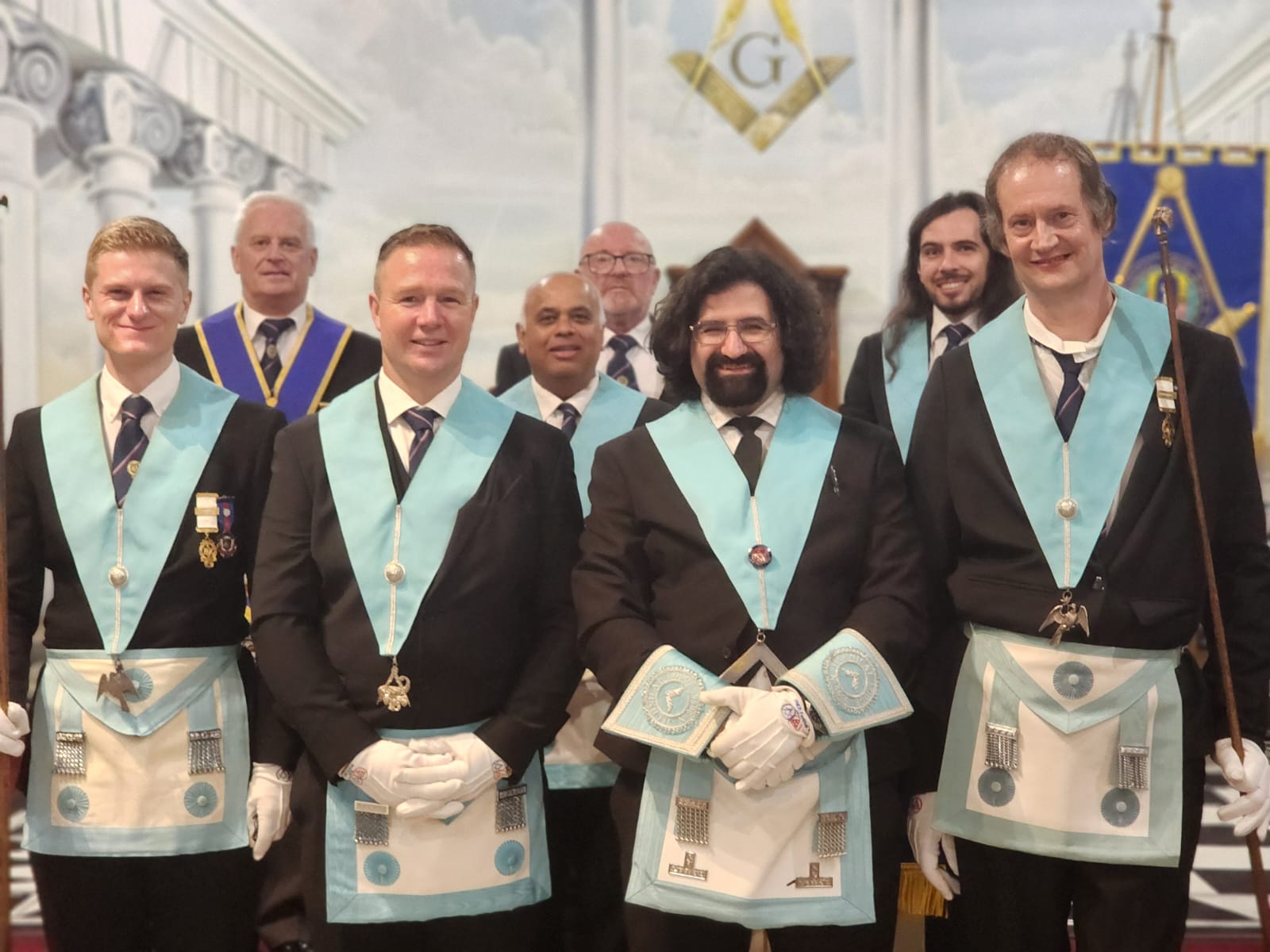
Photograph Credit to W Bro Eddie Wildman
The Festive Board's good humour and incredible food provided a special experience for all. Technical Lodge put in serious work before and during the ceremony to provide Bro Paul an evening that he deserved. The Festive Board provided the perfect refreshment to all and the visitors seemed very gratified. Bro Andy Longstaff of Kirkleatham Lodge gave the response to the Visitor's Toast and he gave hearty compliments to the warm nature of Technical Lodge.
Bro Paul Draper's Raising was the last individual ceremony of Technical Lodge in 2026. Looking forward, we have our Business Meeting in October, Installation in November and Christmas Lodge in December. Although the Lodge Room was still surprisingly hot on this September evening, no doubt the chills of Autumn and Winter will be here soon enough. Certainly, seasons will change... but the warmth and Brotherly Love will always remain at Technical Lodge 5666.
By Anthony James PPGJD
Since taking on my new role as Lodge Mentor, I have been giving quite a bit of thought to what mentoring should actually involve. Of course, there is the obvious side of it: helping brethren develop their Masonic knowledge, encouraging the use of Solomon, supporting newer members and helping them understand a little more about the Craft. But I believe mentoring should go further than that. It should also give us an opportunity occasionally to look at ourselves, our Lodge and, importantly, how we support one another.
One particular subject has been mentioned to me on several occasions, by different brethren and in different conversations. It is something I feel is worth bringing into the open because, although the circumstances have varied, the underlying feeling has often been remarkably similar. It concerns appreciation. Not medals, applause or public recognition, but simply the feeling that when somebody puts considerable time, thought and enthusiasm into something intended to make their Lodge better, that effort is noticed, valued and, perhaps most importantly, engaged with.
There is a curious thing that happens in many voluntary organisations, and Freemasonry is certainly not immune from it. The more enthusiastic and reliable somebody becomes, the easier it is to assume they will simply carry on. At first their contribution is noticed. People ask what they are doing, there is interest and encouragement, and perhaps somebody takes the time to say they enjoyed something or found it useful. Gradually, however, that contribution can become part of the scenery. It simply becomes something that happens. The work continues, so we assume everything is fine.
This article is not aimed at any individual, office or particular circumstance. Nor is it intended as criticism of our Lodge. Rather, it comes from conversations I have had and a growing impression that genuine engagement and support can sometimes be difficult to find. There is also an important distinction to make here. The answer is not necessarily, “Let somebody else do it.” Often the person involved does not want somebody else to do it. They may thoroughly enjoy what they are doing, be deeply invested in it and take great pride in what they are trying to achieve.
Someone may have spent hours researching an idea, organising something, creating material or developing something they genuinely believe will make the Lodge better. The work itself is often not the problem. In fact, it may be something they thoroughly enjoy. The problem begins when enthusiasm appears to travel in only one direction. You can spend hours preparing something, send it out or present it, and receive almost no response. Then, when the subject of support arises, everyone is quick to reassure you: “Keep up the good work”, “That’s a great idea”, or “You’re doing a brilliant job.” All pleasant things to hear, but there is a difference between saying something is worthwhile and demonstrating that you believe it is worthwhile.
When there is little interaction with what is being produced, little participation in what is being organised and little genuine interest in an idea succeeding, those words can eventually begin to feel like lip service. I don’t believe that is usually deliberate. Nobody sets out to make another brother feel unappreciated, and often we say encouraging things because we genuinely mean them. But words and actions need to meet somewhere. Otherwise, however well intended the words may be, their value gradually diminishes.
That raises an interesting question for us as Freemasons: what does genuine support actually look like? Perhaps it begins with engagement. If somebody produces something for the Lodge, read it. If somebody introduces an idea, talk about it. If something is organised, show an interest in it. If somebody asks for opinions, give them. If something particularly interested you, tell them what it was and why. If somebody is trying to encourage participation, participate where you can. None of this involves taking over another person’s responsibilities. Quite the opposite. It demonstrates that their work has reached somebody, and that can matter far more than we realise.
There also appears to be a growing concern, not just within Freemasonry but across voluntary organisations generally, that fewer people are willing to become actively involved. That should concern us because a Lodge cannot thrive indefinitely through the enthusiasm of a small number of brethren while everyone else becomes an appreciative audience. Participation does not simply mean holding an office either. Some of the most valuable contributions to Lodge life happen outside formal roles.
One Brother might research an interesting piece of Masonic history, another may encourage a newer member, organise something socially, communicate with absent brethren or create something intended to make meetings more interesting. Someone else may suggest a new idea or simply bring enthusiasm into the room. These things all help create the character of a Lodge. They are often the difference between a Lodge that simply meets and a Lodge that feels alive. But enthusiasm needs oxygen. Without interaction, even the most enthusiastic person can eventually begin wondering whether anybody is actually interested.
There is also a subtle danger in repeatedly reassuring somebody without genuinely engaging with what they are doing. Eventually, people can tell the difference. Most people do not require constant praise, nor are they looking for applause every time they do something. What they occasionally need is evidence that their effort has mattered. There is an enormous difference between hearing, “That was very good,” and somebody saying, “I read that piece you did. I didn’t know that before, and it made me want to find out more.” The second tells somebody their work actually reached you. That is genuine recognition.
From a mentoring perspective, I think this deserves more consideration than we sometimes give it. We encourage brethren to become involved in Freemasonry. We tell newer members that the more they put into Masonry, the more they will receive from it, and I firmly believe that. But if we encourage involvement, surely, we also have a responsibility to nurture that enthusiasm when it appears. Otherwise, enthusiasm can gradually become disappointment, and disappointment rarely announces itself.
People seldom stand up and declare, “I no longer feel appreciated.” Instead, something much quieter happens. They suggest fewer ideas. They stop asking for opinions. They become less enthusiastic. Something that once received several hours of their attention receives one. Eventually, something they once cared passionately about quietly disappears. Only then does somebody ask, “Whatever happened to that?” Perhaps the better question should have been asked six months earlier.
This isn’t about demanding praise, and nobody should contribute to Freemasonry simply because they want recognition. It is about something much more fundamental: belonging. People want to know that their contribution forms part of something shared. They want to feel that the time they willingly give has some value beyond simply completing a task. When somebody becomes invested in an idea, project or aspect of Lodge life, genuine interest from the brethren around them can be one of the strongest encouragements to continue.
Freemasonry speaks beautifully about Brotherly Love, mutual support and meeting upon the level. Those principles become particularly meaningful in the ordinary moments between ceremonies. Sometimes support is nothing more complicated than a conversation, a response, a little enthusiasm, a genuine question, turning up, taking part or showing somebody that what they spent their evening preparing was actually worth preparing. These may seem like small things, but collectively they create a culture in which people feel that their contribution matters.
So, as your new Lodge Mentor, perhaps I can leave you with a small mentoring challenge. Look around our Lodge and consider the brethren who are actively trying to make something better. Don't look only at the obvious contributions. Look for the quieter ones too. Consider the things that happen regularly, the ideas being developed, the information being shared and the enthusiasm being offered.
Then ask yourself: When was the last time I genuinely engaged with something one of them was trying to achieve?
Not merely thanked them or told them they were doing a wonderful job, but actually showed an interest in what they were doing and why they were doing it. Because sometimes the greatest recognition we can give a brother is not applause, and it certainly isn't offering to take away something he enjoys doing. It is showing him that his effort has made a difference, that his enthusiasm has been noticed and that what he is trying to achieve matters to somebody other than himself.
Perhaps that is something we could all become a little better at. Appreciation should never become just words. In a Lodge built upon Brotherly Love, it should be something we can actually feel through the interest, participation and encouragement of the brethren around us.